

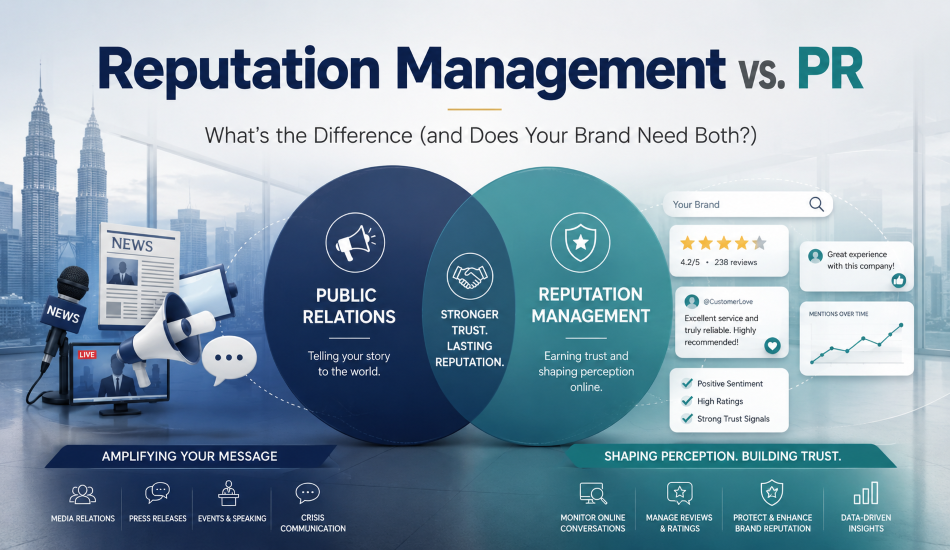
Public relations and reputation management are often used as if they mean the same thing, but they work in different ways. PR is proactive and outward-facing; it’s about building relationships with media, securing earned coverage, and shaping how your brand is perceived before issues ever arise. Reputation management is more reactive and protective; it’s about monitoring and responding to what shows up when someone searches your brand’s name, including reviews, social mentions, and negative press. Both aim for the same outcome, a brand people trust, but they get there through different methods, and most established brands in Malaysia genuinely need elements of both.
What Is Public Relations?
Public relations is the practice of building and maintaining a positive public image through earned media, relationships, and strategic communication rather than paid advertising. A PR team typically works on:
- Media relations: building relationships with journalists and securing coverage in news outlets
- Strategic communications: shaping consistent messaging across every channel a brand uses
- Event management: planning launches, press conferences, and brand activations
- Executive positioning: building visibility and credibility for company leadership
- Crisis communication: managing how a brand responds publicly during a difficult moment
PR is largely proactive. The goal is to build enough goodwill and credibility before something goes wrong that your brand has a foundation of trust to draw on if it does.
What Is Reputation Management?
Reputation management, particularly the “online reputation management” most companies offer in Malaysia today, is a more reactive, technical discipline. It focuses on what appears when someone searches for your brand online: reviews, search engine results, social media mentions, and news coverage that’s already out there.
Typical reputation management activities include:
- Monitoring online reviews and mentions across platforms
- Responding to negative reviews and customer complaints
- Working to improve the search engine results that appear for your brand name
- Identifying and, where appropriate, addressing harmful or inaccurate content online
It’s worth knowing that most companies marketing “reputation management” services in Malaysia are SEO and digital marketing specialists, not communications strategists. Their tools are largely focused on technical content publishing, search optimisation, and review responses rather than relationship-driven. That’s not a criticism; it’s simply a different skill set, and one that’s genuinely useful. But it also means a purely technical approach can only do so much if there’s no real narrative or media relationship behind it.
PR vs. Reputation Management: Side by Side
|
Public Relations |
Reputation Management |
|
|
Orientation |
Outward-facing, relationship-driven |
Reactive, search and review-focused |
|
Timing |
Proactive — builds goodwill before issues arise |
Often triggered after something negative appears |
|
Primary channels |
Media coverage, events, executive visibility |
Search results, review platforms, social mentions |
|
Core skill set |
Storytelling, media relationships, strategic counsel |
SEO, content publishing, review/sentiment monitoring |
|
Best measured by |
Coverage quality, share of voice, message consistency |
Search result sentiment, review ratings, response time |
Where They Overlap
Despite the differences, PR and reputation management aren’t separate tracks; they feed into each other constantly. The media coverage your PR team secures is part of what appears when someone searches for your brand. The sentiment your reputation management team is tracking online often reflects how well (or poorly) your PR messaging is landing. And during an actual crisis, you need both working in sync: a PR team managing the public response and media narrative, and a reputation team making sure that response is visible and well-positioned wherever people are actually searching and reading.
A Practical Example: How PR and Reputation Management Work Together
Imagine a Malaysian F&B brand gets a wave of negative reviews after a customer posts about a bad experience, and the post starts gaining traction on social media.
A reputation management response would involve monitoring the conversation, responding to the original complaint and any follow-up reviews professionally, and working to ensure the brand’s own positive content remains visible in search results alongside the criticism.
A PR response would involve crafting the brand’s public statement, briefing spokespeople on how to address media or public questions if the story grows, and using existing media relationships to make sure any follow-up coverage reflects the brand’s side of the story fairly.
Neither approach alone fully resolves the situation. The reputation management response addresses where people are looking; the PR response addresses what people are actually told. Together, they protect the brand far more effectively than either could on its own.
Which One Does Your Brand Actually Need?
A few questions can help clarify where to start:
Are you trying to build visibility and credibility from a strong position, or repair something that’s already gone wrong?
Building proactively points to PR. Responding to existing negative content points to the need for reputation management.
Is the concern about media narrative, or about what appears in search results and reviews?
If it’s about how your brand is portrayed in the news and by stakeholders, that’s PR territory. If it’s specifically about Google results, review platforms, or social sentiment, that’s reputation management.
Do you already have strong media relationships, but no system for monitoring online sentiment?
Or the reverse solid review management, but no proactive media presence? Either gap is worth addressing and usually points to the need for the side you don’t currently have covered.
For most growing and established brands, the honest answer is both proactive PR to build the narrative and reputation oversight to make sure that narrative holds up wherever people are actually looking for you.
Why an Integrated Approach Beats Hiring an ORM-Only Firm
The risk of hiring a reputation management firm without a PR foundation behind it is that suppression and review management alone can only do so much. Pushing positive content above negative search results works better, and lasts longer, when that positive content is built on genuine media coverage and real brand credibility, not just published to fill space in the search results.
At SLPR Worldwide, reputation management isn’t a separate, bolted-on technical service; it’s built into how we approach PR for our clients from the start. Our team works across strategic PR consultancy, media relations, content marketing, event management, and crisis management, with vigilant monitoring of brand mentions and sentiment running alongside these efforts. That means when something needs managing online, there’s already a real narrative and real media relationships behind the response, not just a search optimisation exercise.
Build a Reputation Strategy That Actually Holds Up
Whether your brand needs proactive PR, reputation oversight, or, as is most often the case, a coordinated combination of both, SLPR Worldwide can help you build a strategy that protects your brand’s image from every angle.
Frequently Asked Questions
Is reputation management the same as PR?
No. PR is proactive and focused on building relationships with media and the public to shape perception over time. Reputation management is more reactive, focused on monitoring and responding to what appears online, reviews, search results, and social mentions about a brand.
Can a PR agency help with negative reviews or search results?
Many PR agencies, including SLPR Worldwide, incorporate reputation monitoring into their broader communications work. The key difference from a pure ORM firm is that the response is backed by genuine media relationships and a consistent brand narrative, not just content published to influence search rankings.
Do I need reputation management if I already have good PR?
It depends on your situation. Strong PR builds credibility and goodwill, but it doesn’t automatically mean your search results, reviews, and online mentions are being actively monitored. If nobody is tracking what’s being said about your brand online day to day, there’s a gap worth addressing, even with strong PR in place.
How much does reputation management cost in Malaysia?
Costs vary widely depending on the scope of monitoring, the platforms involved, and whether the work includes content creation or media relations in addition to monitoring and response. Request a consultation for a tailored quote based on your brand’s specific needs.